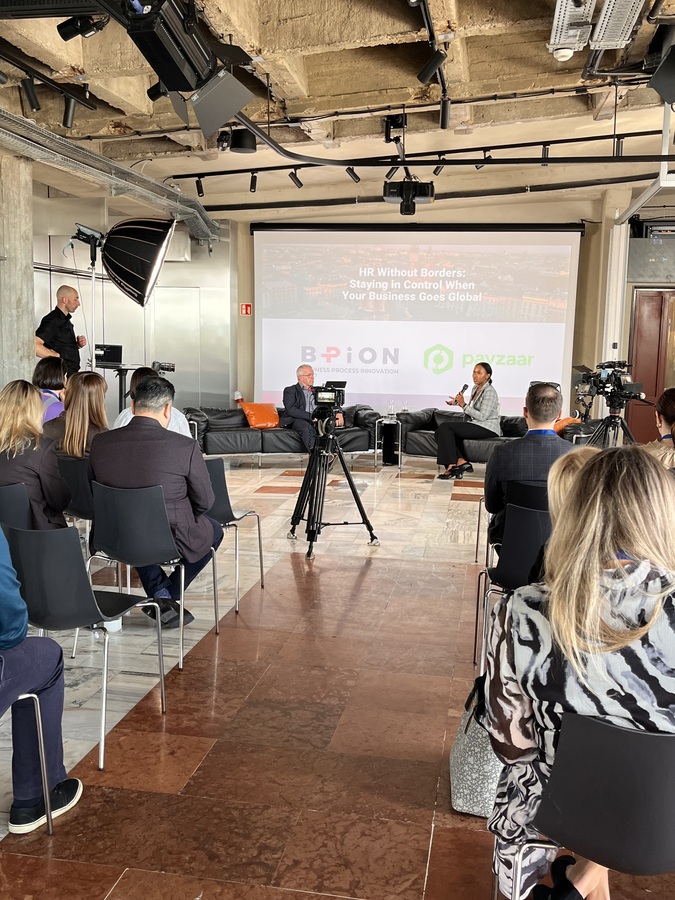
On 29 September, together with Payzaar, we hosted HR Without Borders, a business breakfast at Sky7 in Kraków. HR and payroll leaders from companies opening their first office abroad met those who have been managing teams across several countries for years. When we asked about their biggest challenge, almost half (46%) pointed to international processes and expansion. You can read the full event description in Focus on Business.
The morning, hosted by Kacper Kosowicz, revolved around one question: what does it take for an organisation to stay in control as it grows across borders? Below we bring together what we heard from our speakers and participants, organised around five signs that your multi-country payroll needs attention, and how BPiON Flow can help.
1. Your payroll still runs country by country
Izabela Mazurek-Turska, Senior People & Culture Business Partner, described the moment when reporting lines change and a local team becomes international almost overnight. Many companies assume that everything will fall into place on its own, since English is the standard and the organisation sees itself as modern. Managers often don’t know what they don’t know, and HR has to prepare them before they feel the need.
Payroll follows the same pattern. Each country keeps its own way of collecting data, approving changes and closing the month, and nobody sees the whole picture. Before entering the next market, it pays to map how payroll actually runs in every country you already operate in. BPiON Flow then turns those local habits into one standard workflow for the whole group.
2. Communication runs through email, languages and time zones
Internal communication and organisational culture were the second most common challenge among participants (38%). When we asked about barriers to managing people internationally, a further 27% pointed to communication and time zones. Iza added that language creates silos: internal communication runs in English, while teams serving local clients work in their own language.
In payroll, this shows up as long email threads about whether a given country is ready, with nobody sure who is waiting for whose approval. BPiON Flow replaces those threads with a structured digital workflow, where at any moment you can see:
- what has already been closed.
- which payrolls are in progress,
- what is waiting for approval,


3. Every new country brings labour law surprises
More than half of participants (53%) named different labour laws and regulations as the biggest barrier to managing people across countries. Anna Stasińska-Dyka, a senior HR leader with long experience in international organisations, called labour law the first wall companies hit. Employment rules that feel obvious in one country lose that clarity the moment they have to be applied in another market.
For payroll, the cost of getting it wrong is high: corrections after payday, penalties and employees losing trust. BPiON Flow moves checks to the stage before payroll is closed. It flags unusual changes in pay (known as variance analysis), runs compliance checks and shows on KPI dashboards where risks are emerging, so your team can act in time.
4. Your payroll data comes from several providers in several formats
This was the focus of the panel led by Lisa Kaneza of Payzaar and Kevin Parker, Director at BPiON Global. A company operating in four or five countries usually works with several local payroll providers, each with its own report formats, deadlines and communication style. Someone at headquarters ends up reconciling figures by hand, and comparing labour costs across markets becomes a project of its own. Kevin points out that a process problem in payroll very quickly becomes a people problem.
BPiON Flow sits on top of your existing providers, so you can keep the partners you trust. It maps and validates input data in one standard format before pay is calculated, then automatically compares input and output data. Gross-to-net data from different jurisdictions lands in one consolidated report, and you can drill down from the group view to a single employee or pay element.
5. You plan to introduce AI, but your payroll data isn’t ready
As many as 86% of participants intend to implement AI and automation in HR over the coming year. AI tools need well-organised data, yet in many companies payroll documents still sit in inboxes and on shared drives. With information as sensitive as salaries, GDPR requirements come on top of that.
Before turning to AI, bring your payroll data together and put access to it in order. BPiON Flow keeps all payroll documentation and correspondence in one secure environment and archives it for audit purposes. Role-based access ensures that each user sees only the data and pay groups relevant to them.
Why payroll belongs at the centre
Anna shared the order in which international cooperation usually falls into place. It starts with communication, moves on to processes and then to payroll, which becomes the system around which the rest of HR is organised. Organisational culture comes last. She also noted that even in a mature global structure, difficulties tend to shift to places where everything seems to run smoothly.
This matches what we see with our clients. When payroll across countries runs predictably, HR gains the time and the data to focus on people. As a payroll outsourcing partner, we support that with technology and hands-on expertise: BPiON account managers work on the platform alongside your team on data intake, approvals and reporting, and every step is documented and visible to both sides.
Recognise any of these signs?
You’ll find more details on the BPiON Flow page. If you’d like to see how the platform could bring order to payroll in your organisation, book a demo with Kevin Parker or send us an enquiry. The recording of the global payroll panel from HR Without Borders will be available soon.