Most CFOs know exactly what their payroll vendor charges per payslip. The number is on the invoice, it gets benchmarked, and someone in procurement has probably negotiated it down at least once. What rarely gets measured is the full cost of running payroll, the penalties, the correction cycles, the hours finance spends reconciling data that should never have diverged in the first place, and the quieter damage done when employees stop trusting that they’ll be paid correctly.
The gap between those two numbers is where the real exposure lives.
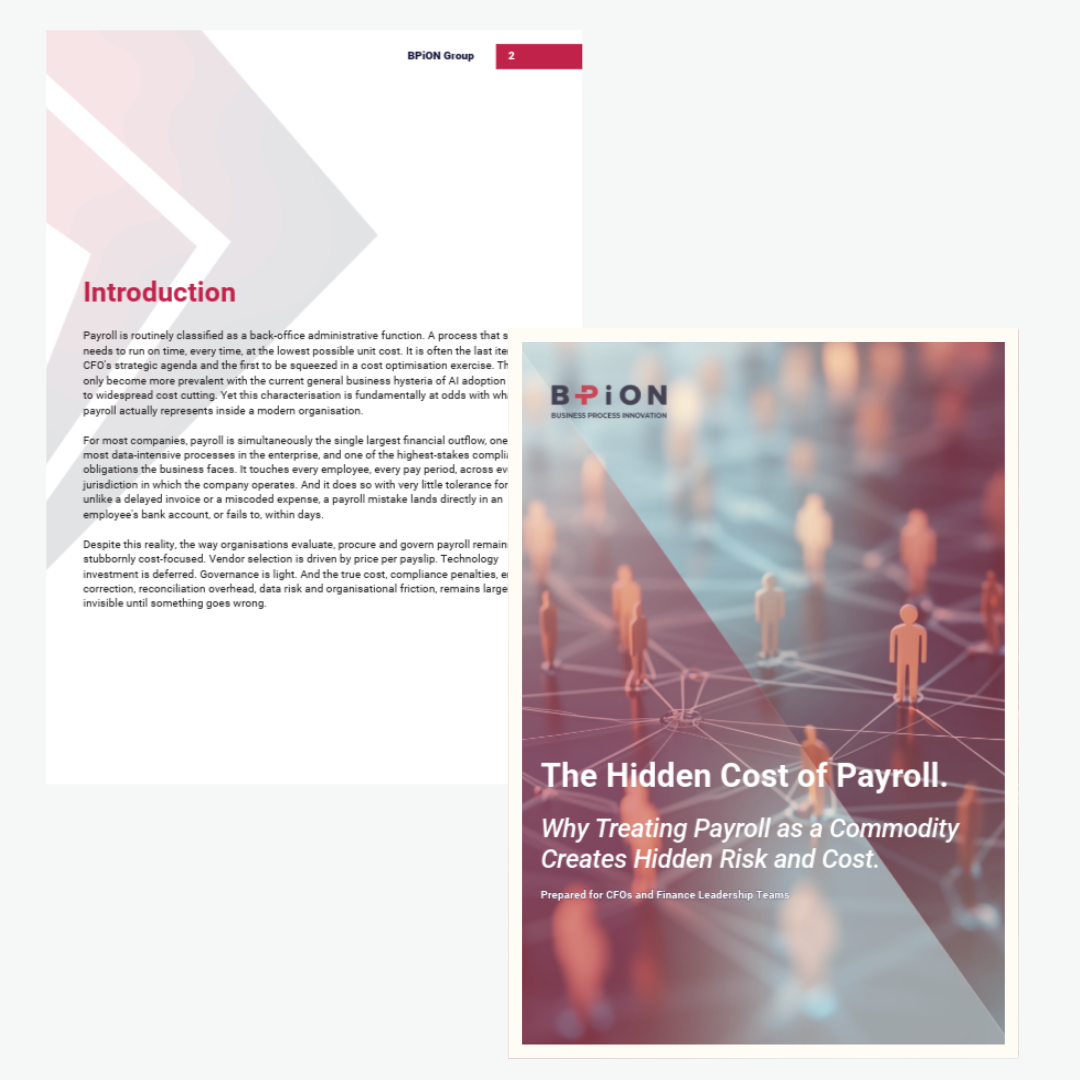
We explore all of them in depth in our whitepaper.
The size of the function matters
For most organisations, total employment cost — salaries, bonuses, employer-side taxes, benefits — represents the single largest category of operating expenditure. In retail, hospitality, or professional services the share is often well above the average. This makes payroll, the process responsible for calculating and disbursing that money, the largest financial process most companies run. It operates on a fixed schedule with no tolerance for delay and very little tolerance for error. A miscoded expense can be corrected quietly in the next reconciliation cycle. A payroll error lands in an employee’s bank account, or fails to, within days.
Given all this, it is striking that the dominant method for evaluating payroll remains the vendor’s per-payslip fee: a metric that captures only the most visible slice of what payroll actually costs to run.
The costs that don’t appear on any invoice
A complete picture of payroll cost includes two distinct layers. The visible layer — vendor fees, software licences, internal payroll staff — is well understood and regularly benchmarked. The hidden layer is where the financial exposure accumulates, largely untracked and unattributed.
Compliance penalties sit at the top of that list. Payroll sits at the intersection of employment law, tax regulation, social security obligations, and data protection requirements, and failures in any of these areas attract regulatory attention. The particularly costly aspect of compliance failures is that they tend to be invisible until they crystallise. An organisation may be non-compliant with a local reporting requirement for months before a regulatory review triggers a penalty assessment, at which point accumulated back payments, interest, and fines create a liability far larger than the compliance infrastructure that would have prevented it.
Payroll errors are more frequent than most finance leaders assume, and each one carries a correction cost that goes well beyond the payroll team. Recalculating the affected transaction, reprocessing the payment, investigating how the error occurred, and refiling with the relevant authority if required, all of this draws on time across payroll, finance, HR, and sometimes legal. In manual or fragmented environments, error rates tend to be meaningfully higher than in well-automated systems. The individual costs may seem manageable, but across a full year they accumulate into a significant unbudgeted liability that rarely appears in any payroll cost model.
Reconciliation overhead is another cost that vendors do not price into their proposals. When payroll, HR, time-tracking, and finance systems are not integrated — a situation that remains common even in otherwise sophisticated organisations — finance teams carry the burden of manually reconciling data across sources every cycle. The working hours consumed by this process represent real capacity lost to a problem that better integration would largely eliminate. As organisations grow and add jurisdictions, the burden scales with them.
Vendor fragmentation creates governance risk that is harder to quantify but equally consequential. Multinationals running separate local payroll providers across their operating markets often have no consistent view of total employment cost, no standardised compliance reporting, and limited visibility into where problems are developing before they become penalties. The organisation’s ability to govern payroll risk is constrained by the opacity of the network it has built.
Data security rounds out the picture. Payroll databases contain bank account details, tax identification numbers, and full salary histories for every employee — a concentration of sensitive personal data that carries significant regulatory exposure under GDPR and equivalent frameworks in other jurisdictions. Payroll systems are among the most data-sensitive in the enterprise, yet they often run on older infrastructure with less rigorous security practices than customer-facing systems receive.

How failures spread
A payroll error rarely stays in the payroll function. A missed filing deadline or a calculation affecting a large employee cohort tends to pull in finance for emergency corrections, HR for employee communications, legal to assess exposure, and tax to file amendments. If external auditors detect anomalies, their scope typically expands, at additional cost and considerable distraction for management.
The employee dimension compounds this further. Research consistently shows that payroll errors have a measurable effect on employee trust and retention. A workforce that experiences repeated inaccuracies begins to question the organisation’s basic operational competence, and employees who feel financially let down are more likely to look elsewhere. In competitive labour markets, the cost of replacing experienced staff lost to a preventable payroll failure is substantial.
The global layer
For organisations operating across multiple jurisdictions, every risk described above becomes harder to manage. Each country adds its own regulatory environment, its own reporting cadence, and its own annual cycle of tax and social security updates. Currency translation introduces additional accounting complexity. Governance structures that function well for a domestic payroll operation tend not to scale when the function is distributed across many markets, each managed by a separate vendor with minimal central coordination.
This is a structural problem, and it responds to structural solutions, consolidated vendor models, standardised reporting frameworks, and payroll systems that integrate meaningfully into the wider finance stack.
Check our whitepaper – The Hidden Cost of Payroll.
Measuring what actually matters
Payroll transformation involves real cost. The more useful question is how that cost compares to the current, largely unmeasured cost of the status quo.
A genuine total cost of ownership analysis — one that captures compliance penalties, error correction costs, reconciliation overhead, and integration debt alongside the standard vendor and staffing line items — usually changes the picture significantly. Assessing compliance posture across every operating jurisdiction reveals where unrecognised exposure sits. Mapping the gaps between payroll and finance systems makes the reconciliation burden visible and quantifiable. Tracking error rates, compliance incidents, and reconciliation cycle times as standard financial KPIs puts payroll governance on the same footing as every other operational risk the business manages.
What integrated payroll makes possible
A well-integrated payroll function generates continuous, granular data on workforce cost — by department, geography, and business unit — that has genuine value for financial planning. Finance teams with real-time visibility into labour costs as they accrue can run tighter variance analysis, make better-informed headcount decisions, and build more accurate operating models. The function shifts from something the business waits to hear from at the end of each cycle to an active source of financial intelligence.
That shift is available to most organisations. The barrier is usually the assumption that the current approach is cheaper than the alternative — an assumption that rarely survives a rigorous and complete cost analysis.
BPiON works with finance and HR leadership teams across multiple jurisdictions to build payroll operating models that reduce compliance risk, eliminate reconciliation overhead, and generate the workforce cost intelligence that modern finance functions need.
Contact: